Insights
Infinite Productivity: The AI Trap
7 min
How can we stop if AI never stops?
The promise was reasonable, almost kind: Artificial Intelligence would help us work less on what adds little value, so we could work better on what truly matters. Less time wasted on searches, versions, summaries, follow-ups, documents no one wanted to write, and meetings that should never have existed. Finally, we thought, a technology capable of giving us back some mental space. But every technological promise has a dark side when it enters organizations that have not yet learned how to prioritize.
Microsoft is already speaking about the emergence of the "Infinite Workday" Syndrome: 40% of people active online at 6:00 in the morning are checking email, and the average worker receives 117 emails and 153 Teams messages a day.
AI does not arrive in a serene world. It arrives in a system that was already saturated, where the possibility of boundlessly increasing productivity has generated a new "Infinite Productivity" Syndrome.
AI is an indisputable accelerator of efficiency, but it produces a dangerous sensation of limitless work capacity.
By delegating repetitive tasks to AI, we assume we are unburdening ourselves, that we get less tired, and that we multiply our capacity to do other "more important" tasks. But we forget a few details: scientific literature has shown that AI constantly accelerates delivery times and raises response expectations.
In addition to personal exhaustion, this level of demand causes professional burnout due to oversight overload and the required pace of adaptation.
When Infinite Productivity shifts from being a possibility to a workflow model, it becomes a trap.
Responsibility lies with individuals, but above all, with organizations. If we do not redesign this system, it will not grant us more freedom; it will only give us more capacity to keep running.
The Risk of Chronic Burnout
The pursuit of infinite productivity considers the capabilities of machines, but not of humans. Unlike people, AI has no schedule, no vacations, and no visible fatigue, and it is dragging us to keep up with its pace. Its dizzying progress, faster than our capacity to adapt, generates a series of complex psychological tensions in humans that have already been identified by current scientific evidence:
Psychological and Emotional Impact
The speed with which AI assumes human tasks challenges the adaptive capacity of our nervous system, triggering specific psychological responses:
AI Anxiety and Job Insecurity:
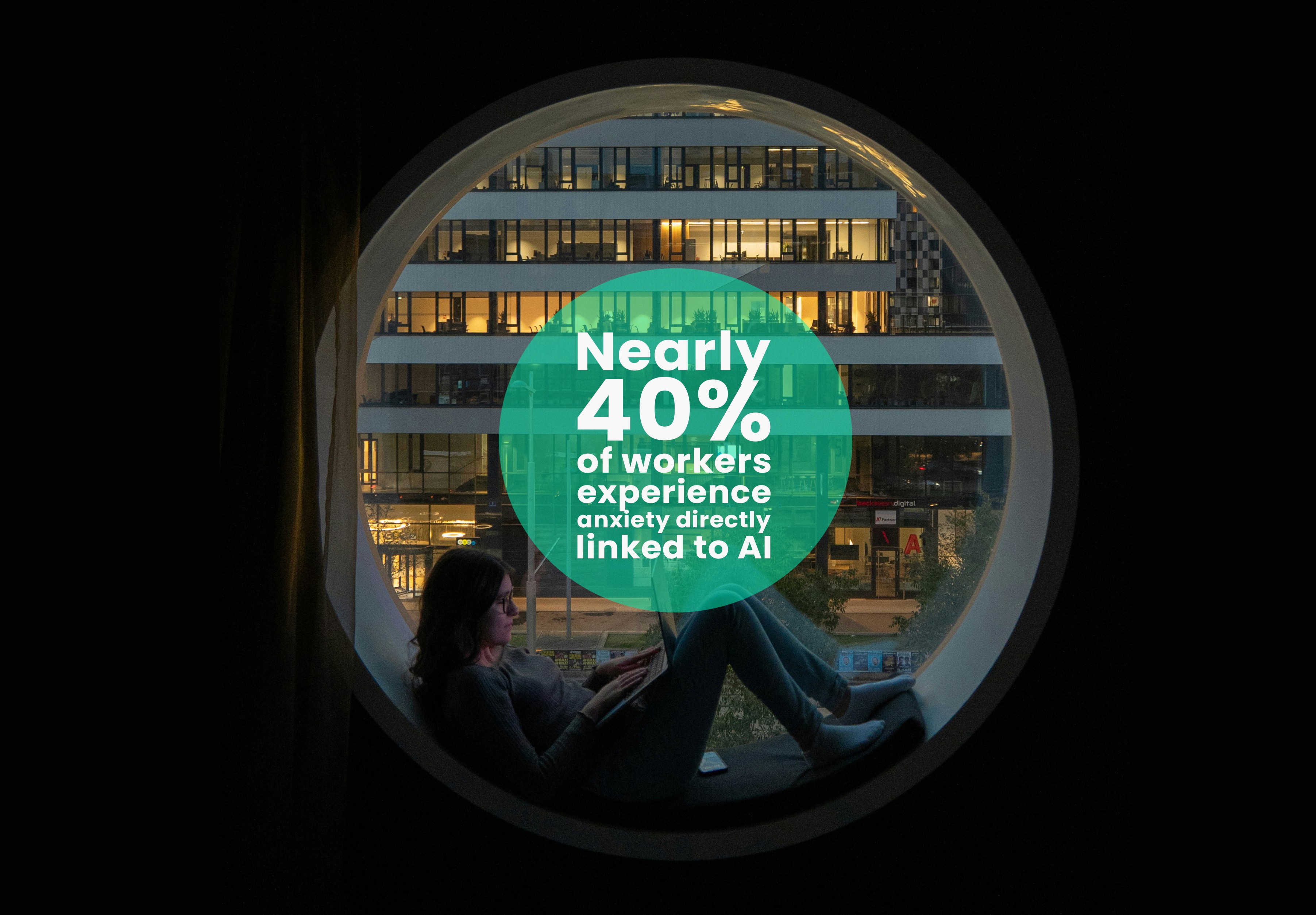
Nearly 40% of workers experience anxiety directly linked to AI. It is not a fear of the technology itself, but of their professional future.
Identity Crisis and Self-Esteem:
Work does not just provide income; it provides identity, purpose, and a sense of competence. When an AI performs a complex task in seconds that took a professional years to master, the individual can experience a loss of identity, feelings of uselessness, and resentment.
Continuous Adaptation Fatigue ("Future Shock"):
The need for uninterrupted reskilling generates anticipatory stress, keeping workers in a state of permanent cognitive alertness.

Problems at a Personal Level
The exhaustion of the digital environment and automation inevitably spills over into individuals' private lives:
The "Infinite Workday" Syndrome:
By delegating repetitive tasks to AI, it is assumed that the human "rests." However, delivery times decrease and response expectations grow. This fragments recovery time, causing workers to take their mental burden home, interfering with sleep (insomnia) and family relationships.
Isolation and Loss of Human Connection:
As workflows are optimized through man-machine interactions, social touchpoints decrease—a key factor for depression and chronic loneliness.
Information Overload and Decision Fatigue:
AI processes and churns out massive volumes of data that humans must oversee, filter, and sign off on. This daily avalanche exhausts the brain's executive resources, leaving people too depleted at the end of the day to make everyday decisions in their personal lives.
Consequences for Professional Performance
Paradoxically, the tool designed to multiply productivity can impair performance if it is not managed under occupational health criteria:
The Vicious Cycle of Burnout and Intensification:
Efficiency analyses (such as those by ActivTrak) reveal that following AI adoption, the volume of tasks and multitasking usually increase, while "deep work" decreases. AI does not eliminate work; it often changes its nature to one of constant and accelerated supervision, which raises mental exhaustion and, in the medium term, destroys performance.
"Cognitive Drag" and Presenteeism:
Chronic stress from technological future uncertainty causes employees to operate under a state of constant distraction. Although they are physically in front of the screen, their ability to concentrate is notably reduced, increasing human error rates and emotional disconnection from the company.
Erosion of Psychological Safety and Creativity:
For a professional to innovate or perform at their peak, they need an environment where it is safe to fail. The latent fear of being replaced by an algorithm penalizes experimentation. Workers tend to become hyper-vigilant and submissive to software standards, nullifying critical thinking and personal initiative.

AI in a Healthy Work Environment
There is a consensus in Organizational Psychology: AI has the potential to alleviate workload and improve well-being if it is used to grant greater autonomy to the worker. The real risk of its "limitless" capacity is not the software, but the tendency of organizations to use that speed to demand humanly unsustainable performance, transforming a tool of liberation into a multiplier of pressure.
There are many tools we can use personally to utilize AI well and control its negative effects on our work and our lives.
Instead of understanding our productivity as an infinite volume of work, let's seek to optimize and prioritize: the secret lies in sustainability and focus. [1, 2, 3]
These are some key principles we can apply to optimize our time and energy:
Single-tasking focus:
The human brain can only focus on one cognitive task at a time. Avoid multitasking.
Time blocking:
Work in deep focus intervals of no more than 90 minutes, followed by mandatory breaks.
Radical prioritization:
Apply the Pareto Principle (80/20): identify the 20% of your tasks that generate 80% of your results.
Tool limits:
Don't fall into the trap of using too many applications. Limit your tools to the essentials.
Rest is productive:
Disconnect without guilt and respect your own rhythms.

But stopping, in the era of AI, cannot be solely an individual responsibility
The system always wins over the individual. We can ask people to set boundaries, turn off notifications, learn to rest, and "manage their energy better." All of that helps. But if the organization rewards the person who responds fastest, admires the one who automates the most, and continues to measure value by volume of activity, resting becomes an act of private heroism against a public culture of permanent availability. Gallup shows that global engagement dropped to 20% in 2025, its lowest level since 2020, with stress, sadness, and anger still above pre-pandemic levels. This does not seem like the best terrain to add 24/7 agents without a serious conversation about focus, cadence, and boundaries.
The uncomfortable question, then, is not whether AI can help us do more. Of course it can. The question is whether we will have the organizational maturity to decide when not to do it.
At re.set, we usually say that Business Agility is not about moving all the time, but about creating value with greater clarity: focus, OKRs, cadences, transparency, continuous learning, and the capacity—as unglamorous as it is decisive—to say no. AI needs that discipline more than any previous technology because it doesn’t just execute work: it multiplies options. And an organization without criteria can die not from a lack of capacity, but from an excess of possibilities.
Stopping, in this new context, will not be a soft pause.
It will be a strategic competence. The difference between using AI to increase our intelligence, or to increase our exhaustion.
Subscribe to receive the latest news from our blog