Insights
The fight against time
5 min

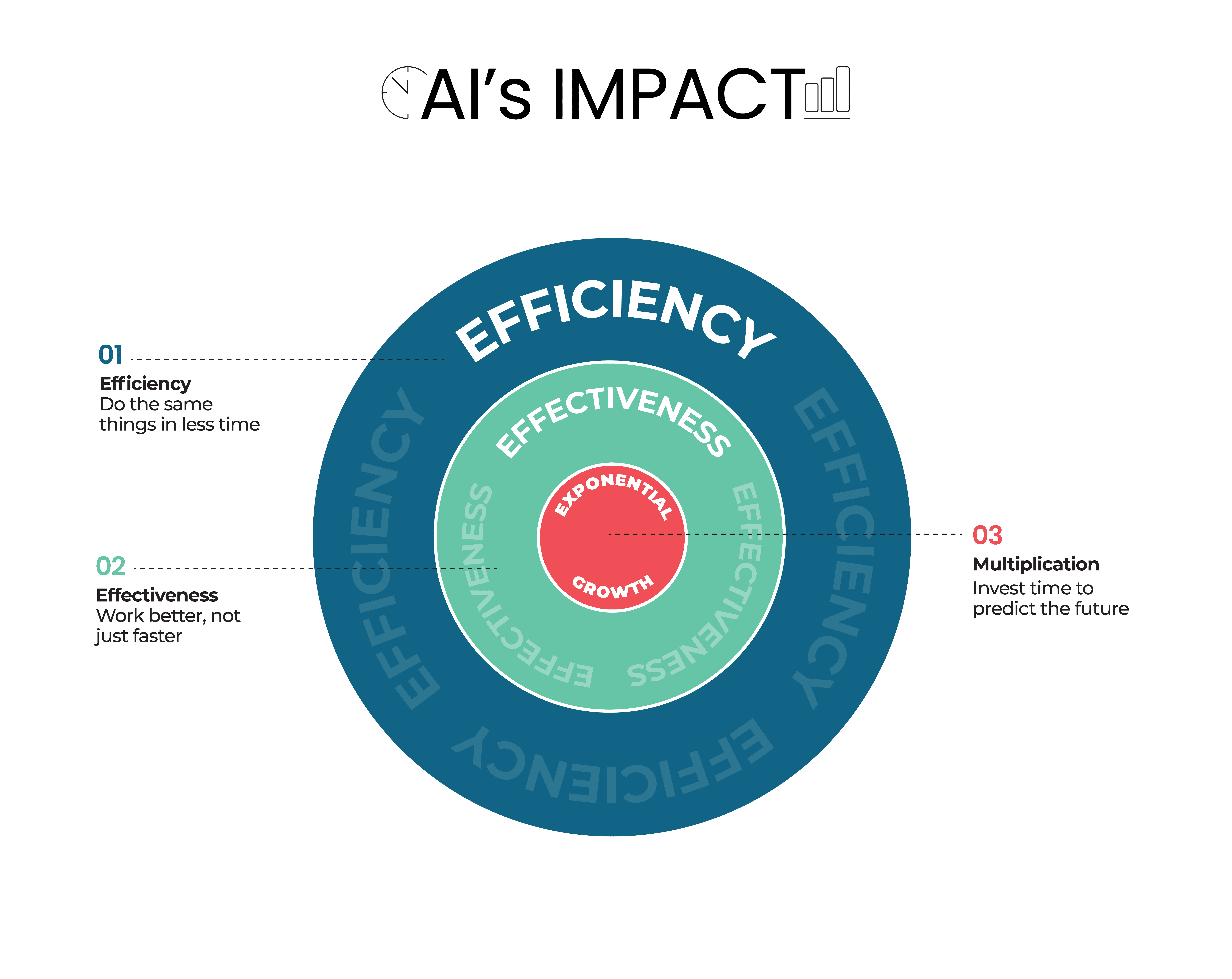
AI has made three promises to organizations about time. Most are only cashing in on only one.
There’s a phrase we hear often from the teams we work with: “we don’t have time.” No time to think things through. No time to do projects properly. The day ends before the to-do list does, and that list grows back overnight.
In most cases, this isn’t a complaint or an excuse — it’s the consequence of the pressure organizations are under, combined with outdated ways of working. Urgency wins over importance. Speed over substances. Outputs over outcomes. And no matter how fast teams run, they rarely feel like they’re actually getting anywhere.
Into this context, artificial intelligence has arrived with an appealing promise: we’ll give you your time back — or at least help you stop losing it. And to some extent, it’s delivering. But that promise, properly understood, isn’t one thing. It’s three. And the difference between organizations that are genuinely transforming how they work — and how their teams experience that work — and those that have simply layered new tools onto the same old problems, lies exactly there.
FIRST PROMISE
Do the same things in less time
This is the most visible promise, and the fastest to deliver. AI copilots summarize meetings, draft documents, organize scattered information. Tasks that used to take a couple of hours now take minutes. Friction drops. Execution speed goes up.
For many teams, this has been a genuine relief. Getting two hours back in the day isn’t nothing — especially when those hours were going to tasks that required effort but not judgment.
The problem is that many organizations have stopped here. They’ve optimized the time they already had, without asking whether they were using it well in the first place.
Gaining efficiency on top of a broken way of working isn’t transformation. It’s accelerating in the wrong direction. And with AI, you can do that faster than ever — which in many cases backfires, because the feeling of moving quickly toward nowhere generates even more anxiety.
This first promise is necessary. But it isn’t enough on its own.
SECOND PROMISE
Work better, not just faster
This is where real transformation begins.
Organizations that are getting the most out of AI haven’t just gained speed — they’ve recovered space to think. Their teams spend less time hunting for information, building documents from scratch, or rehashing conversations they’ve already had. And they’re not using that recovered time to do more of the same. They’re using it for the things that always mattered but never had room: listening more carefully to clients, debating ideas with more depth, making decisions with more clarity.
The result isn’t just more productivity. It’s better work. And better work, sustained over time, produces something that efficiency metrics don’t capture well: teams that feel competent, that trust what they do, that don’t end the day with the sense of having run hard and arrived nowhere.
That’s what we mean by working better. And it’s exactly the promise re.set has spent years trying to help organizations keep — with or without AI.
The difference now is that with the right tools and a well-designed transformation, that promise is more achievable than ever — and the results show up much sooner. Organizations that are keeping this promise notice it not just in their outcomes, but in the quality of their teams’ professional lives.

THIRD PROMISE
Invest time to predict the future
The first two promises are about recovering time. This one is about multiplying it.
Some organizations have reached a point where AI doesn’t just help them move faster or work more effectively — it helps them make better decisions, sooner. It surfaces patterns that were previously invisible. It models scenarios that used to take weeks to analyze, or that simply never got analyzed at all. The time they invest in thinking clearly today pays back tomorrow, and next quarter, and the year after.
This is the compounding effect of time well invested. It’s not about doing more in the same day — it’s about each good decision today preventing three problems next week. Each anticipated scenario avoiding a crisis that would have consumed months. Each well-designed AI-assisted process freeing people to do what machines can’t: judge, create, connect, lead.
Organizations that get here don’t just work differently. They’ve learned to make time work for them, instead of working against it.
This is the most demanding promise. It requires having worked through the first two. And it requires something that goes beyond tools: an organizational culture that knows what to do with what AI surfaces, and leadership capable of turning that information into decisions.
BEFORE YOU ACT
An honest diagnostic
Most organizations that say they’re “transforming with AI” are, in practice, operating on the first promise. That’s not a failure — it’s a starting point. The problem is mistaking it for the destination.
To understand where your organization actually stands — and how to move toward the next stage — these questions can be useful. There are no right answers, but there are revealing ones.
On how you use time:
— Is the time AI has freed up being used for something different, or just to do more of the same?
— Is there space in the calendar for thinking, not just executing?
— Do teams feel like they’re making progress, or like they’re just surviving?
On how AI is integrated:
— Is AI integrated into how you work as an organization, or is it a tool each person uses on their own?
— Are there shared criteria for what to delegate to machines and what not to?
— Do middle managers know how to lead teams that work with AI, or are they improvising?
On the impact on people:
— Has the technological transformation improved your teams’ professional lives, or has it added new pressure on top of the old?
— Does your most valuable talent have more room to do what they do best, or are they still trapped in operational tasks?
— Would you be comfortable explaining to your team what kind of organization you want to be in three years?

HOW TO MOVE FORWARD
Three things to start with
Distinguish between adoption and transformation.
Teams using AI tools doesn’t mean the organization is transforming. Adoption is individual and tactical. Transformation is collective and strategic. The first happens on its own. The second requires intention, structure, and support.
Define what you’ll do with the time you recover.
This is the step almost no one takes. The question isn’t just “what can we automate” — it’s “what do we want to do with the time automation gives us back?” Without a clear answer to that second question, efficiency becomes noise.
Measure what matters, not just what’s easy to measure.
Hours saved are easy to count. Decision quality, team energy levels, and the ability to anticipate problems — not so much. But those are the things that determine whether an organization is moving toward the second and third promises, or just running faster.
WORKING WELL IS POSSIBLE
At re.set, we’ve spent years working with agencies and marketing teams to help them work better. Not just faster — with more clarity, less internal friction, and structures that unlock talent instead of blocking it.
The arrival of AI hasn’t changed that mission. It’s expanded it. Because now the conversation about how organizations work is also, inevitably, a conversation about what they do with the time technology gives them back.
All three promises exist. But none of them fulfill themselves. They require intention, structure, and a conscious decision about what kind of organization you want to be.
Organizations that only cash in on the first promise gain speed. Those that also claim the second gain quality. Those that reach the third gain something that doesn’t show up in any results presentation, but that everyone can feel: the sense of building something that actually means something.
That’s what working better means to us.
re.set · theagilereset.com
Subscribe to receive the latest news from our blog